by @DaemonOrtega
Brief Content
This brief analyses the content of the 2023 and 2024 Commission reports for both Bosnia & Herzegovina (B&H) and Albania, alongside the subsequent parliamentary committee reports and amendments. It includes a look at voting patterns among Political Groups and key amendments. The brief concludes with an assessment of how these parliamentary positions reflect broader strategic concerns about EU enlargement methodology and geopolitical competition in the Western Balkans.

Background of Union Accession
The European Union enlargement process represents one of the Union’s most significant foreign policy instruments, serving as a mechanism for extending European values of democracy, rule of law, and human rights beyond the Union’s frontier. The current legal framework governing EU accession is the ‘Copenhagen Criteria1’, adopted in 1993, which establishes the fundamental conditions candidate countries must fulfil to achieve membership.
The accession process operates through a structured negotiation framework comprising 35 Chapters of the EU Community acquis, including items ranging from free movement of goods, to science and research, to external relations, and more2. These are typically bundled into six thematic clusters to keep relevant Chapters better organised, and to help determine the overall pace of negotiations: (1) fundamentals; (2) internal market; (3) competitiveness and inclusive growth; (4) green agenda and sustainable connectivity; (5) resources, agriculture, and cohesion; and (6) external relations. Each individual Chapter requires meeting opening benchmarks before negotiations begin and closing benchmarks for provisional closure, with final closure occurring only upon full compliance verification.
Central to the current enlargement methodology is an emphasis on the ‘Fundamentals’ cluster, consisting of Chapters 23 (Judiciary and Fundamental Rights) and 24 (Justice, Freedom, and Security). These encompass judicial independence, anti-corruption frameworks, fundamental rights protections, border management, asylum systems, and migration policy. These chapters require meeting interim benchmarks throughout the process, with sustained implementation verified through regular assessment reports like the ones discussed in this brief for Bosnia & Herzegovina and Albania.
Accession processes typically span 10–15 years from initial application to membership. Albania broadly follows this pattern, having applied for EU membership in 2009 and opened accession negotiations in 2022, while Bosnia & Herzegovina submitted its application much later in 2016. Of the two, Albania has advanced further in the negotiation process, having opened negotiations on ‘Cluster 1: Fundamentals’ in October 2024 and ‘Cluster 6: External Relations’ in December 2024.
Both the Commission and Parliament play a role in monitoring accession progress through annual country reports and resolutions, which provide democratic oversight of the enlargement process. Dissecting these most recent documents will be the subject of this Enlargement Brief.
Analysis: Bosnia & Herzegovina
Commission’s 2024 Assessment: Persistent Institutional Challenges
The European Commission’s 2024 report found Bosnia & Herzegovina making limited progress across most areas while grappling with persistent institutional dysfunction. The Commission assessed the country as oscillating between an early stage of preparation and having some level of preparation in most areas, with progress significantly hampered by entity-level obstructionism.
On democratic institutions, the Commission identified fundamental challenges as the functioning remained “undermined by persistent discriminatory elements in the constitutional structure and by the persistent breaching of the legal and constitutional order by the Republika Srpska entity”. The entity “continues not to implement the decisions of the Constitutional Court, calling into question the authority and integrity of the Court”, while adopting separate election and referendum laws aimed at usurping state competences, which the Constitutional Court suspended and repealed.
For public administration reform, the Commission found the country “between an early stage and some level of preparation” but making some progress, notably through establishing coordination mechanisms and adopting a state-led civil service law in March 2024. However, implementation of the strategic framework remained critically low at just 16%.
On rule of law, the Commission documented “limited progress” while highlighting “persistent and evident signs of deterioration” requiring urgent measures to restore judicial integrity. Economic governance remained “negatively affected by resurfacing political tensions”, with the country staying “at an early stage of preparation” for a functioning market economy and marking only limited progress.
The Commission concluded that while political commitment brought results between November 2023 and March 2024, “the reform dynamic stalled between April and October 2024, among political controversies and the political campaign for the October local election”.
Parliament’s Draft Response
Rapporteur Ondřej Kolář (Renew Europe)’s draft report in March 2025 struck a balance between supporting Bosnia & Herzegovina’s EU aspirations while underscoring significant security concerns and institutional challenges. Parliament’s initial response largely aligned with the Commission’s assessment but placed greater emphasis on geopolitical threats and the need for sustained reform momentum.
The draft report emphasised strong parliamentary support for Bosnia’s European path, noting that “75% of its population support the accession” and acknowledging the country’s “crucial role in the European Union’s enlargement strategy”. Parliament welcomed the European Council’s decision to open accession negotiations in March 2024, recognising this as a milestone achievement following the country’s candidate status being granted in December 2022.
However, the report also expressed serious concerns about destabilising forces, particularly the Republika Srpska entity3’s continued defiance of state institutions. Parliament identified “significant risks and limitations that cannot be underestimated”, specifically highlighting how the “Republika Srpska entity and its head Milorad Dodik4 [pose] a threat by maintaining close ties with Russia” and warned that these forces “make Bosnia & Herzegovina a battleground for hybrid operations, foreign interference, and disinformation campaigns”.
The draft acknowledged that B&H must fulfil the 14 key priorities set by the Commission’s 2019 Opinion to ensure a “functional democratic state, equal opportunities for people, public administration efficiency, and economic growth”. Parliament emphasised the ongoing need to develop a national programme for EU acquis adoption and strengthen anti-corruption efforts.
On broader geopolitical challenges, the draft warned of potential declining pro-EU sentiment across the Western Balkans due to shifting international dynamics, noting that “the EU must acknowledge and prepare for a possible looming downslide in pro-EU approach in Western Balkan countries, including Bosnia & Herzegovina, and not allow the Georgian scenario to take place there”. Despite these challenges, Parliament concluded that “by embracing necessary reforms, strengthening the rule of law and fighting the foreign influence, Bosnia & Herzegovina will become part of the European family”.
Parliamentary Amendments
The amendment process in April 2025 included 314 amendments tabled by various political groups.
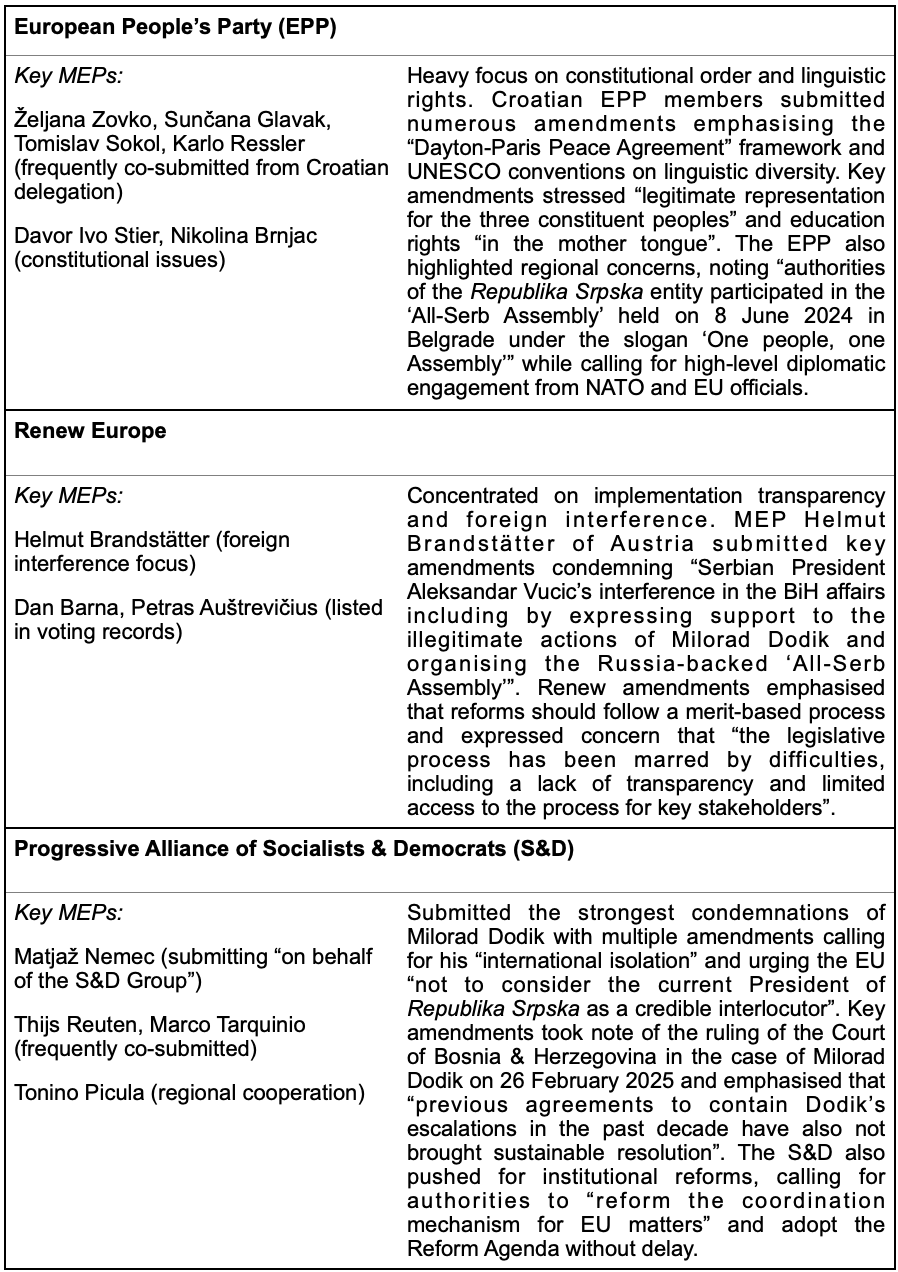
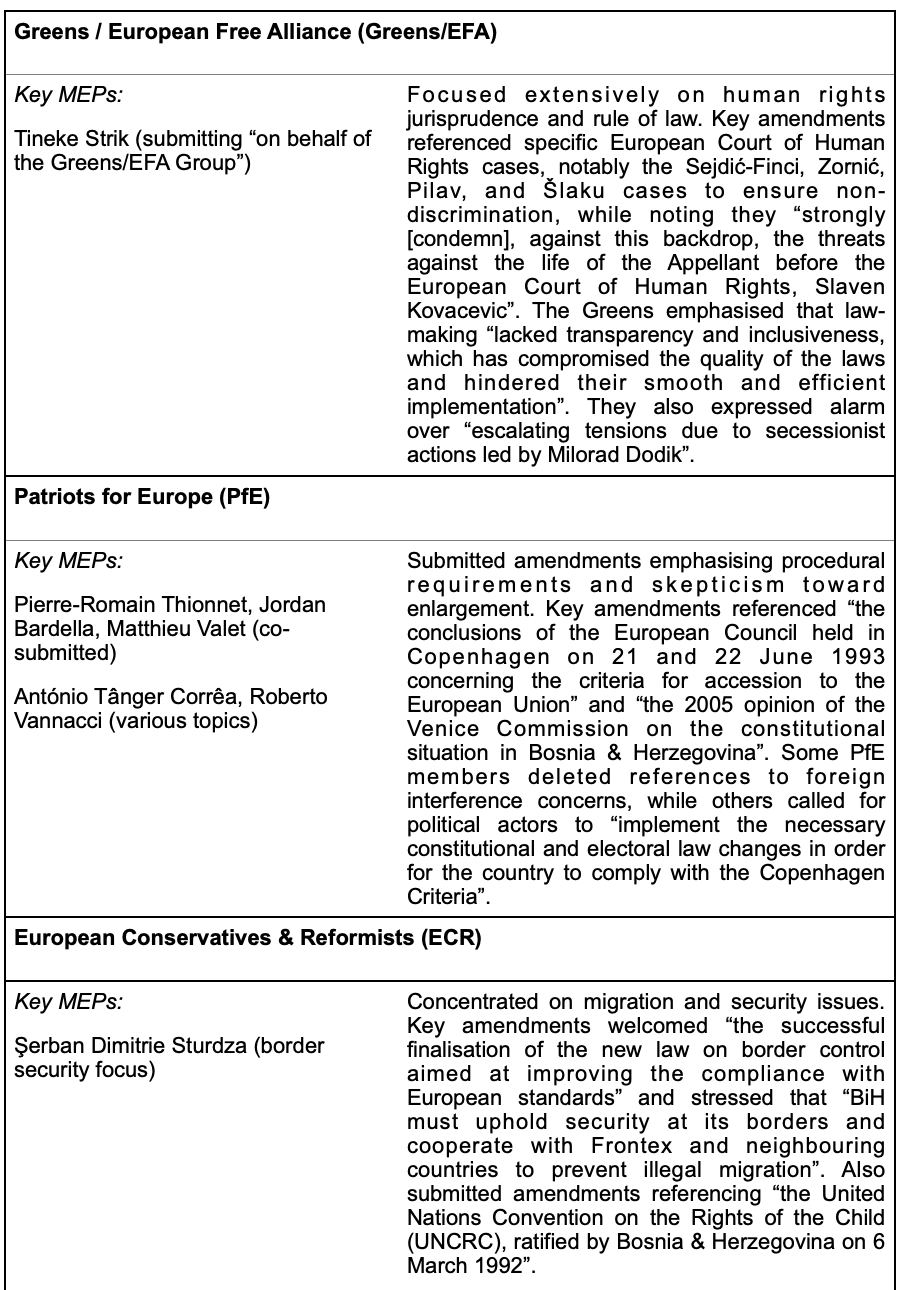
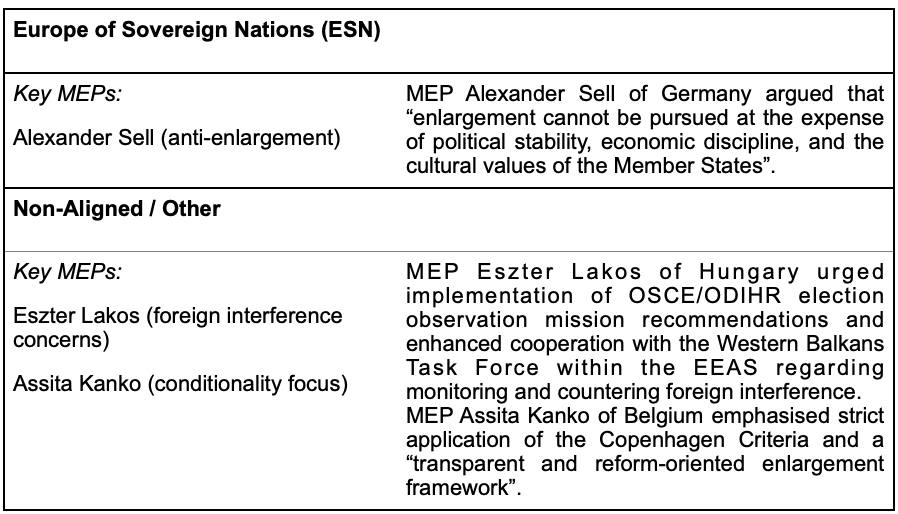
Final Committee Report: Solid Pro-Enlargement Consensus
The final committee report was adopted on 4 June 2025 with strong cross-party support: 56 votes in favour, 13 against, and 5 abstentions. This substantial majority demonstrated considerable parliamentary backing for B&H’s EU path despite ongoing institutional challenges. The pro-enlargement coalition included EPP, S&D, Renew, Greens/EFA, The Left, and most ECR members, while opposition came primarily from PfE, ESN, and some non-aligned members.
The final text incorporated several key amendments that strengthened the report’s focus on constitutional order and foreign interference. Notably, the document included references to high-level diplomatic engagement, “having regard to the visits of the High Representative Kaja Kallas and of NATO Secretary General Mark Rutte in BiH in March and April 2025” and “the statement of the President of the European Council António Costa to the political leaders of BiH in April 2025”, highlighting sustained international attention on the country’s trajectory.
Parliament’s final position maintained strong condemnation of Republika Srpska entity’s defiance while emphasising constitutional frameworks. The report acknowledged that “Milorad Dodik’s SNSD party has been excluded from the ruling coalition in BiH and a process of forming a new pro-EU majority has been initiated”, suggesting optimism about political realignment. The text preserved language about “malign foreign interference” and incorporated warnings about “Russian state-controlled media, including Sputnik Serbia and RT Balkan” operating “especially in Republika Srpska, spreading disinformation and pro-Kremlin narratives”.
On constitutional matters, the final report struck a balance by acknowledging the Dayton-Paris Peace Agreement while emphasising that it “continues to form the foundation of BiH’s institutional set-up and a safeguard for the equality of its three constituent peoples and citizens”. Parliament also addressed the complex electoral reform challenge by referencing specific European Court of Human Rights cases while calling for constitutional and electoral law changes to ensure non-discrimination and equality.
The document concluded with Parliament’s commitment that “by embracing necessary reforms, strengthening the rule of law, and fighting the foreign influence, Bosnia & Herzegovina will become part of the European family”, demonstrating sustained institutional support.
Analysis: Albania
Commission’s 2024 Assessment: Steady Progress With Challenges
The European Commission’s 2024 report on Albania assessed the country as “moderately prepared” across most areas while noting “some progress” in key reforms. Albania successfully opened accession negotiations on the ‘fundamentals’ cluster in October 2024, marking a significant milestone, though the Commission identified ongoing challenges in political polarisation and institutional capacity.
On democratic institutions, the Commission found that Parliament “can exercise its powers in a mostly satisfactory way” but noted that “its oversight over the executive remains limited”. Political tensions significantly affected parliamentary activity between October 2023 and March 2024, with “continuous clashes between the ruling majority and a part of the opposition” reflecting a “lack of constructive and inclusive political dialogue”. Despite Parliament’s return to normal functioning in March 2024, political polarisation remains high and continues to “negatively impact Parliament’s key legislative and oversight roles and extend delays in appointing individuals to key positions”.
For public administration reform, Albania “remains moderately prepared” but made only “limited progress” in delivering on the previous year’s recommendations. The Commission welcomed the creation of a new Minister of State for Public Administration & Anti-Corruption in January 2024, which “provides a clear political leadership for the [Public Administration Reform] agenda and should improve the overall coordination of the reform efforts”.
On rule of law, the Commission documented significant achievements through the judicial vetting process, which approached completion at first instance with 798 out of 805 cases finished by October 2024, representing 99% completion. The Specialised Structure for Anti-Corruption & Organised Crime (SPAK) “has continued to produce good results by further advancing in the prosecution and investigation of complex anti-corruption cases, including those involving high-level politicians and officials”. However, concerns remained about continued political interference and pressure on the judicial system, as well as “shortcomings in the merit-based appointments of non-magistrate members” of key judicial councils.
Economically, Albania continued to pursue stability-oriented economic policies to successfully narrow its budget deficit and reduce its public debt ratio. The Commission noted Albania’s significant integration achievements, including joining the Single Euro Payment Area (SEPA) in 2024 and removal from the Financial Action Task Force (FATF)’s ‘grey list’ in October 2023, demonstrating improved anti-money laundering standards.
Parliament’s Draft Response
Rapporteur Andreas Scheider (S&D)’s draft report in March 2025 struck an optimistic tone while emphasising the urgent need for continued reform. Parliament’s initial response largely aligned with the Commission’s assessment but focused more so on Albania’s geopolitical significance and the need to address democratic vulnerabilities.
The draft report welcomed Albania’s “unwavering commitment to EU integration, reflecting consensus among political parties and overwhelming support among citizens” and commended its “consistent full alignment with the EU’s common foreign and security policy and promotion of the rules-based international order”. Parliament particularly praised Albania’s stance during its UN Security Council term, noting its role as co-penholder of resolutions condemning Russia’s war of aggression against Ukraine.
Parliament welcomed Albania’s ambitious timeline to close accession negotiations by the end of 2027, acknowledging the rapid progress made in recent years, notably the opening of two clusters of negotiating chapters in 2024: ‘Cluster 1: Fundamentals` in October 2024 and ‘Cluster 6: External Relations’ in December 2024.
However, the report emphasised that “the peace of EU accession is determined by the candidate country’s progress on aligning with the EU acquis, its track record on implementing it, and the due functioning of all the country’s institutions” and urged Albania to “accelerate reforms to strengthen the rule of law, counter corruption and organised crime, and ensure the protection of fundamental rights, including freedom of expression”.
The draft welcomed the EU’s new Reform & Growth Facility for the Western Balkans, which will provide €922 million in grants and loans to Albania when conditions are met, and took note of Albania’s adoption of the National Plan for European Integration 2024–2026 while calling for “greater efforts to increase transparency and engage in public communication on EU integration”.
On electoral matters, Parliament acknowledged the July 2024 amendments to Albania’s Electoral Code enabling out-of-country voting and introducing partially open candidate lists, but stressed the need to “address and implement the outstanding recommendations from the OSCE/ODIHR5 and the Venice Commission6”.
Parliamentary Amendments
The amendment process in April 2025 included 236 amendments tabled by various political groups.
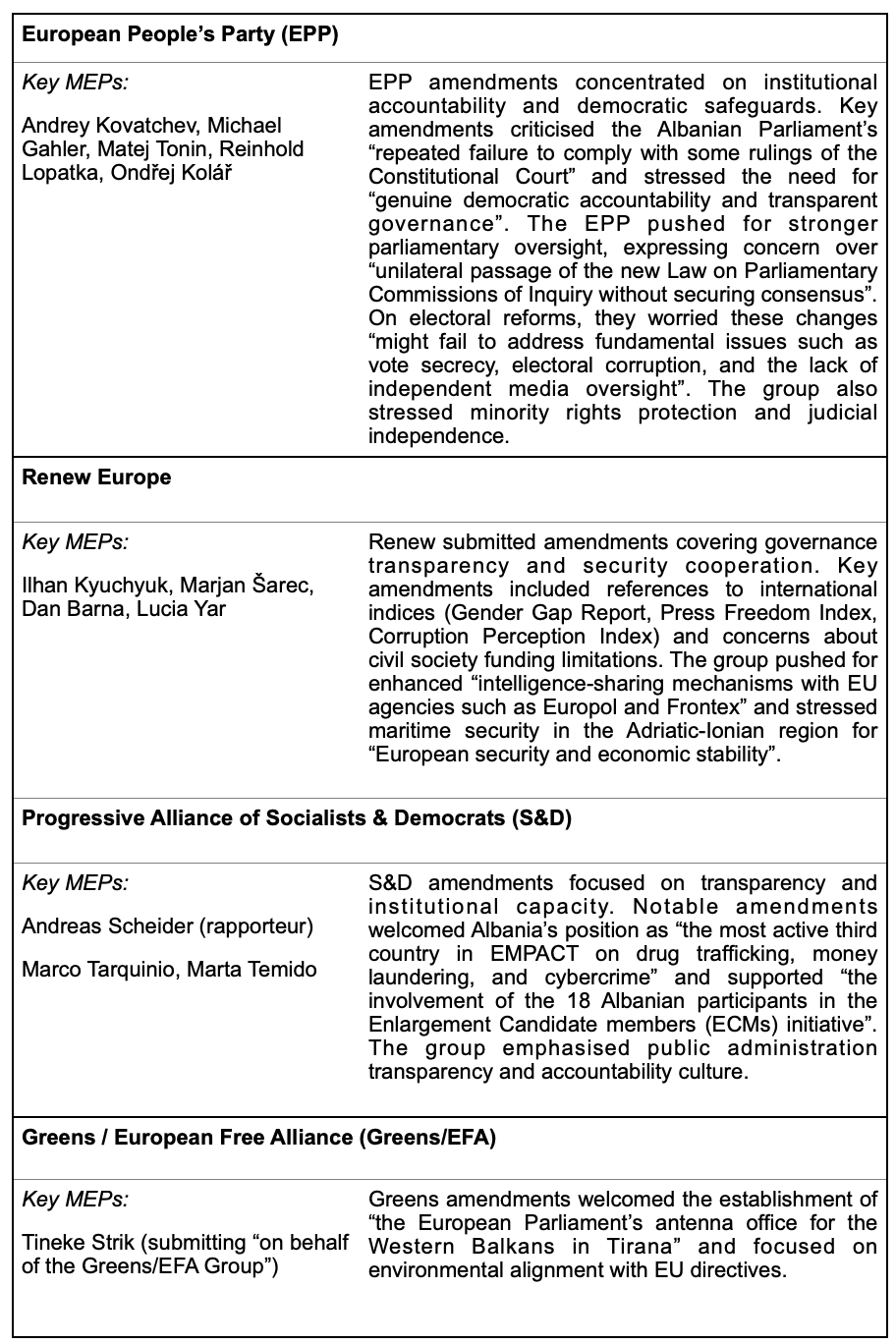
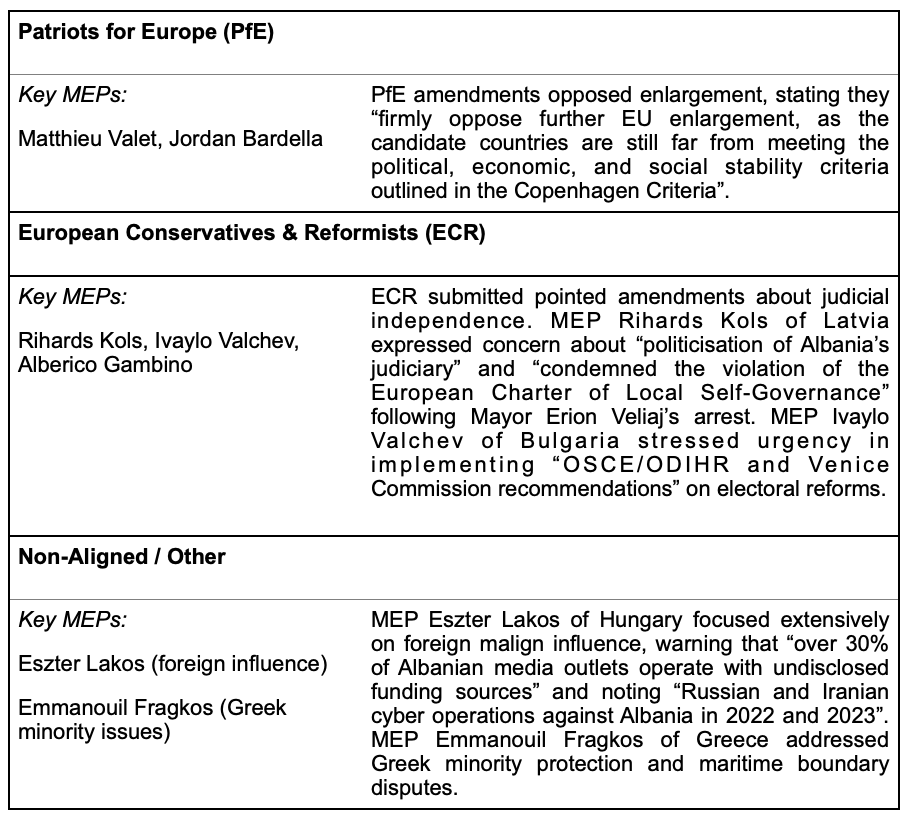
Final Committee Report: Strong Pro-Enlargement Consensus
The final committee report was adopted on 4 June 2025 with cross-party support: 57 votes in favour, 11 against, and 6 abstentions. This majority demonstrated substantial parliamentary backing for Albania’s EU aspirations, with pro-enlargement forces (EPP, S&D, Renew, Greens/EFA, The Left, and most ECR) forming a coalition while opposition came primarily from PfE and some non-aligned members.
The final text incorporated several critical amendments that strengthened Parliament’s focus on hybrid threats and institutional accountability. Most prominently, the document recognised “the growing threat of foreign malign influence and hybrid interference in Albania’s democratic institutions” and called for enhanced “institutional resilience against covert political funding, media manipulation, and cyber threats that directly impact its EU accession process”. The report welcomed Albania’s blocking of Russian disinformation domains while advocating for “increased regional cooperation among Western Balkan countries to share best practice[s] and develop joint strategies in combatting disinformation and foreign interference” and warning of “the increasing footprint of Chinese state-backed media in Albania”.
On constitutional governance, the final text emphasised “the Albanian Parliament’s duty to respect the rulings of the Constitutional Court without delay” and stressed “the fundamental and irreplaceable role of [the Albanian] Parliament in safeguarding checks and balances”. Parliament called for “genuine democratic accountability and stronger, more transparent governance”.
Regarding electoral developments, the report took note of both the July 2024 electoral code amendments and the parliamentary elections of 11 May 2025, noting that while elections “were competitive and professionally conducted” according to OSCE/ODIHR preliminary conclusions, they “took place in a highly polarised environment and contestants did not enjoy” equal conditions, indicating a continued concern by Parliament about democratic quality in Albania despite technical progress.
The final document maintained Parliament’s broad support for Albania’s ambitious 2027 accession timeline while incorporating security, governance, and reform priorities that reflected cross-party consensus on the challenges facing Albania’s democracy.
Conclusions
The European Commission’s assessments of Bosnia & Herzegovina and Albania reflect the all-to-familiar challenges inherent to the Union’s current enlargement strategy: comprehensive technical evaluation coupled with measured optimism about incremental progress. While both countries demonstrate genuine commitment to European integration — with 75% of Bosnians supporting accession and Albania maintaining its ambitious 2027 timeline — their experiences expose fundamental flaws in how the EU translates substantial financial and technical support into political momentum and public confidence.
The disconnect between EU investment and local perception represents both a communication failure and a strategic vulnerability that threatens the core objectives of enlargement. Despite mobilising impressive amounts of resources (€9 billion through the Economic & Investment Plan, extensive technical assistance programmes like EURALIUS, and (now) prominently branded infrastructure projects) the Union struggled for decades to demonstrate tangible progress to citizens who view EU membership as perpetually out of reach. The historic misalignment between EU engagement and regional needs created a perception gap that competitors like China have been quick to exploit. When citizens in the Balkans observe Chinese-branded infrastructure while EU projects remain administratively delayed or poorly publicised, the political consequences extend far beyond immediate economic impact.
Perhaps most troubling is the institutional recognition of these dynamics coupled with an apparent unwillingness to adapt. The European Parliament’s own assessment warns that “the EU must acknowledge and prepare for a possible looming downslide in pro-EU approach in Western Balkan countries, including Bosnia & Herzegovina, and not allow the Georgian scenario to take place there”. Yet the same document concludes with the familiar refrain that “by embracing necessary reforms, strengthening the rule of law, and fighting the foreign influence, Bosnia & Herzegovina will become part of the European family”, essentially prescribing more of the same approach that created the problem to begin with. This contradiction reveals an institution that understands the gathering storm but remains wedded to stagnation — unable to generate enthusiastic political momentum.
For the Union to fulfill its enlargement commitments and secure its strategic interests in the region, fundamental reform of both method and visibility is needed. This requires moving beyond the current model of arms-length technical assistance toward a visible partnership, ensuring EU engagement is unmistakably present in citizens’ daily lives. Infrastructure projects should carry prominent, permanent EU branding with clear messaging about European partnership.
Most critically, the accession process must evolve from a slow-moving procedure with scant recognition into a dynamic framework that rewards genuine progress with concrete integration steps — embracing a concept of ‘graduated European integration’ that offers candidate countries increasing levels of inclusion as they meet criteria.
The stakes extend beyond institutional efficiency to the Union’s fundamental credibility as a geopolitical power. An enlargement process that demands much yet delivers little visible progress ultimately serves neither European interests nor the practical needs of candidate countries.
https://ec.europa.eu/commission/presscorner/detail/en/doc_93_3 ; https://www.europarl.europa.eu/enlargement/ec/pdf/cop_en.pdf ;
https://enlargement.ec.europa.eu/enlargement-policy/conditions-membership/chapters-acquis_en
https://www.diplomatie.gouv.fr/en/country-files/bosnia-herzegovina/news/article/bosnia-herzegovina-concerning-developments-in-the-republika-srpska-entity-22 ; https://www.aa.com.tr/en/europe/bosnia-s-serb-entity-adopts-draft-constitution-granting-self-determination/3510099 ; https://balkaninsight.com/2025/05/29/bosnias-constitutional-court-scraps-serb-entitys-disputed-laws/ ; https://www.aljazeera.com/news/2023/1/9/why-is-republika-srpska-day-controversial-in-bosnia ;
https://www.euronews.com/my-europe/2025/04/24/bosnian-police-fail-to-arrest-republika-srpska-leader-milorad-dodik
https://www.osce.org/files/f/documents/b/b/13701.pdf
https://www.venice.coe.int/webforms/documents/