
Full Meeting Minutes – Internal Ave Europa Strategic Debate on European Defence
(Consolidated with EDIP, the White Paper on the Future of European Defence, and grounded political-industrial context)
The session began with a tone of frank, and methodological humility. From the outset, participants acknowledged the complexity of the subject matter.
European defence is not a monolith but a network of systems, doctrines, supply chains, standards, and political traditions.
As one member noted with a touch of irony, “We’re not generals, and that’s probably why we’re still speaking to each other.” Another chimed in, adding that precisely because none of us has a vested institutional agenda to defend, we can explore solutions more freely.
Still, there was no mistaking the urgency: the consensus was clear that Europe can no longer afford strategic naïveté or institutional immobility. The war in Ukraine has made this brutally evident. Two broad imperatives framed the entire conversation:
- Europe must be able to produce war materiel at scale in the event of prolonged or high-intensity conflict — with as little external dependency as possible.
- The development costs of cutting-edge defence systems must be amortised through integrated EU procurement and exports. Without that, fragmentation and duplication will continue to make Europe’s industry less competitive and less capable.
These imperatives directly mirror the logic behind the European Defence Industry Programme (EDIP) adopted in 2025 — a legislative and financial framework designed to ensure that Europe’s defence sector becomes less reactive and more anticipatory. EDIP’s emphasis on secure supply chains, minimum EU content thresholds (70%), crisis preparedness, and support for Ukraine was referenced more than once as a good baseline — but not sufficient in itself.
A recurrent theme was the persistent fragmentation of defence procurement. Despite repeated calls for integration, each Member State still protects its own champions. Political and industrial sovereignty still dominate over collective efficiency. As one member put it: “We’re always stuck at the same place. Everyone’s willing to cooperate — as long as it’s their firm getting the contract.”
A concrete proposal emerged early and found wide support: European defence firms should open production and R&D branches in other Member States. Not just symbolic offices — real factories, logistics hubs, innovation centres. If Dassault had operations in Hungary, Leonardo in Finland, Rheinmetall in Spain, or KNDS in Romania, political resistance to joint procurement would soften. It’s not just about spreading the money; it’s about sharing sovereignty at the operational level.
The comparison to the F-35 programme in the United States was illustrative. Although assembled in Texas, the aircraft draws on components from over 40 states. This isn’t economically optimal, but politically necessary. No congressman wants to kill a project that creates jobs in their district. Europe, some argued, could adopt a similar “federalist industrial strategy” — not by mimicking the U.S. but by designing its own logic of cross-border entanglement, shared dependencies.
That led the conversation toward interoperability and standardisation. Many acknowledged that thanks to NATO, a great deal has already been achieved. Calibres are harmonised. Maintenance standards and logistics protocols are increasingly shared. Someone mentioned — likely drawing from personal military experience — that an Italian logistics battalion could now supply a Swedish tank regiment without friction. Another noted that he’d used a German G36 rifle and knew it was compatible with ammunition and maintenance infrastructure from Poland, Finland, or Spain.
Yet the consensus was that interoperability is not integration. The White Paper on the Future of European Defence, published in March 2025, makes this point as well: technical compatibility doesn’t automatically yield political readiness. Europe can resupply each other’s battalions. But can it command them together?
This brought us to the command question. “Don’t worry about uniforms,” someone said — “worry about command and logistics.” Camouflage can stay national. Command cannot. Especially in joint deployments. The discussion highlighted that the real bottleneck is the absence of a strategic centre. The Commission proposes. The Council approves. But no one commands.
There was a strong push — across federalist and pragmatic lines alike — to establish a European Defence Council. Not to centralise military power in Brussels, but to give it a locus of coordination. This Defence Council could be composed of national defence ministers, or permanent appointees, empowered to interface with NATO and take rapid operational decisions. The aim isn’t to rival NATO but to ensure that European forces can act when Americans won’t.
Others went further, advocating for a European expeditionary corps — a modular, rapid deployment force under a central European command. Not a super-army. But a first layer. Symbolic, functional, accountable. One person likened it to the French Troupes de marine or the U.S. Marine Corps. Such a force, they argued, could carry strong public legitimacy — especially if it were made democratic in structure and oversight.
But scepticism was also voiced. A few warned of the risks of over-politicising the command structure. “Let the Council control the politics. Let a military structure manage the operations,” someone said. This bifurcated model — a political council and a European Defence Command — gained traction as a workable duality. It preserves national legitimacy while allowing operational unity.
The conversation then looped back to industrial innovation. EDIP rightly promotes mid-cap and SME inclusion and balanced geography. But concerns were raised about over-consolidation. If integration means locking out new actors, Europe will lose its edge.
Several participants made strong appeals for an ecosystemic approach. The analogy to Israel’s dual-track model came up multiple times: a system where large defence contractors work alongside — and often incubate — highly disruptive start-ups in drones, AI, cyber, etc. A few members floated the idea of a European Defence Innovation Fund, possibly under the EIB, to support deep-tech ventures at the seed and scale-up stages. One suggested modelling it after DARPA — not in governance, but in ambition.
Another point of consensus was that none of this is achievable without public investment. EDIP provides a useful start. But the broader envelope of the Multiannual Financial Framework (MFF) remains too constrained. A few floated the possibility of a European Sovereignty Fund, distinct from the Innovation Fund, aimed at co-financing defence infrastructure and new production capacities.
What does all this amount to?
At least four transitions, clearly articulated by the end of the session:
– From fragmentation to interdependence, not just between armies but across industries and supply chains.
– From redundant national production to aggregated European scale, especially in artillery, tanks, radar, and C4ISR.
– From passive NATO compatibility to active EU autonomy, not by exiting the Alliance but by becoming a sovereign pillar within it.
– From institutional inertia to political responsibility, meaning a shift from voluntary cooperation to shared capacity, and eventually shared obligation.
One participant remarked that the European army — often debated in the abstract — already exists in fragments. Eurocorps in Strasbourg. Rotating EU Battlegroups. PESCO projects. EDIP instruments. But what’s missing is a clarified mandate and a shared belief that Europe should be able to act without asking permission.
The debate never concluded on a single model. Some still preferred intergovernmental logic. Others wanted democratic oversight at EU level. A few floated the idea of a European Security Council, with each state naming a Defence representative who would also serve as liaison to NATO and a potential central command.
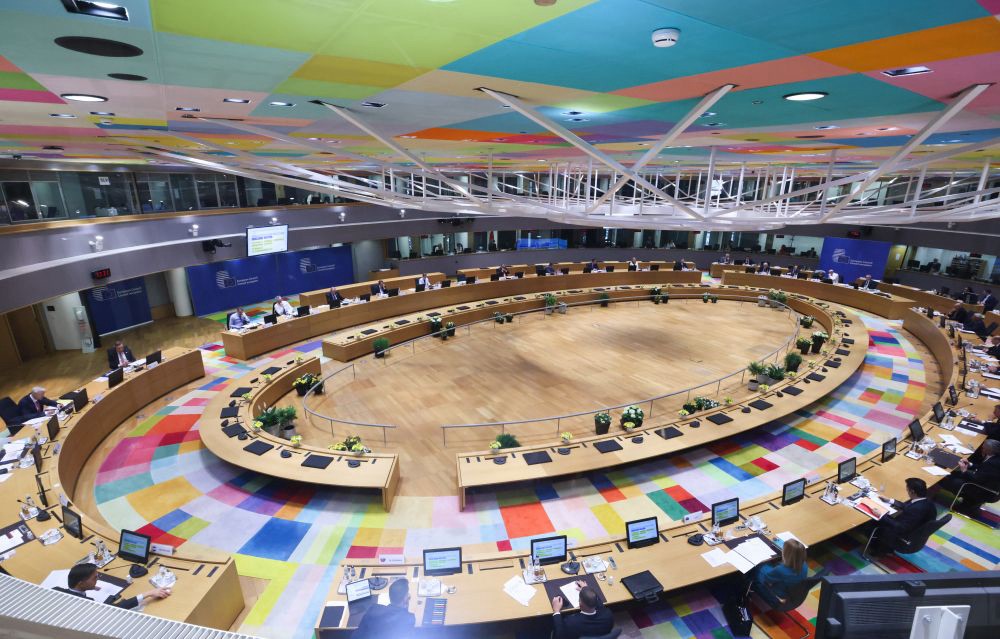
As the exchange concluded, what gradually took shape was not a singular vision, but a shared grammar — a set of recurring terms, converging logics, and orienting intuitions. The challenge of European defence, as discussed, cannot be solved by a singular institutional leap or by a technical fix. Rather, it requires a structural reconfiguration across four interdependent axes: capacity, coordination, command, and coherence.
Capacity, first. The starting point was unanimously recognised: Europe must secure the material means of its defence. This is not a question of symbolic autonomy, but of strategic viability. The EDIP regulation reflects this imperative — ensuring production, procurement, and supply resilience within a crisis-responsive industrial ecosystem. The need for scalability in production, geographical distribution of industrial sites, and a reliable capacity for surging output under stress was acknowledged as foundational.
Coordination, then. Fragmentation was identified as a core dysfunction. The multiplication of redundant platforms (MBTs, artillery systems, etc.) drives up costs and inhibits interoperability. The rationalisation of procurement — not as uniformity but as market-based harmonisation — was seen as the pragmatic path forward. Industrial policy must pursue demand aggregation and supply chain compatibility, without stifling competition or innovation. The analogy with the US F-35 industrial model — territorialised to ensure political buy-in — served here as a functional precedent, not a federalist ideal.
Command -. A central line of convergence was the need for a shared operational infrastructure. The goal is not the substitution of national armed forces, but the layering of a joint command and logistics architecture that enables coordinated deployments, pooled maintenance, and operational readiness. NATO remains the practical matrix for interoperability, but the ambition — echoed in both the White Paper and EDIP — is to move from mere compatibility to a European decision-making framework in times of deployment. This implies establishing a European Defence Command, complemented by a political governance structure (European Defence Council), capable of linking inter-governmental executive legitimacy, operational execution with democratic due process and institutional continuity.
Coherence – Lastly. The broader strategic coherence of European defence was seen as dependent on its political economy: adequate funding, innovation incentives, and a balanced industrial map. Participants advocated for a model that avoids both over-centralisation and laissez-faire fragmentation. The solution advanced was an ecosystemic defence model: combining major players with disruptive SMEs, nurturing dual-use technologies, and embedding public investment (e.g. via a possible Sovereignty Fund or EIB-backed innovation vehicles) into long-term strategic planning.
Throughout the session, a conceptual distinction repeatedly re-emerged: European defence is not equivalent to a European army. The more productive framework is that of a functional federation — a decentralised but interoperable system of capabilities, governance, and shared assets. What is being built is not a unified military force, but a mesh of national sovereignties woven into a coherent architecture of readiness.
This architecture should be modular, scalable, and politically accountable. The idea of a European expeditionary force — however limited — was seen as a potential catalyst: both operatively useful and symbolically unifying. Yet even here, the emphasis remained on measured construction: building from what exists (Eurocorps, Battlegroups, PESCO), rather than inventing ex nihilo.
At no point did the debate lean towards utopianism. Instead, it unfolded around a strategic realism: the understanding that Europe already possesses the ingredients — institutional, industrial, operational — but lacks the connective tissue. What is missing is not only funding or governance, but a common sense of risk and responsibility.
In closing, three structural insights appear to synthesise the discussion:
First, defence integration must proceed through function, not form: begin with logistics, maintenance, and command synchronisation, rather than symbolic declarations.
Second, the role of political initiative is crucial, but must be embedded in institutional clarity — avoiding both bureaucratic inertia and industrial capture.
Third, European defence must be embedded in democratic deliberation, not remain the preserve of technocratic logic or intergovernmental patchwork. Strategic autonomy must ultimately mean political accountability.
Thus, the conclusion was not prescriptive, but directional. It pointed not to a singular European defence “solution”, but to a set of structural convergences — each of which must now be translated into concrete institutional and budgetary commitments.
The debate left open the exact format of integration. But it closed on a shared recognition: Europe cannot remain strategically adult in rhetoric, while institutionally adolescent in defence. The political moment demands that Europe move from cautious coordination to structured sovereignty — not by suppressing its diversity, but by building a system able to operate through it.