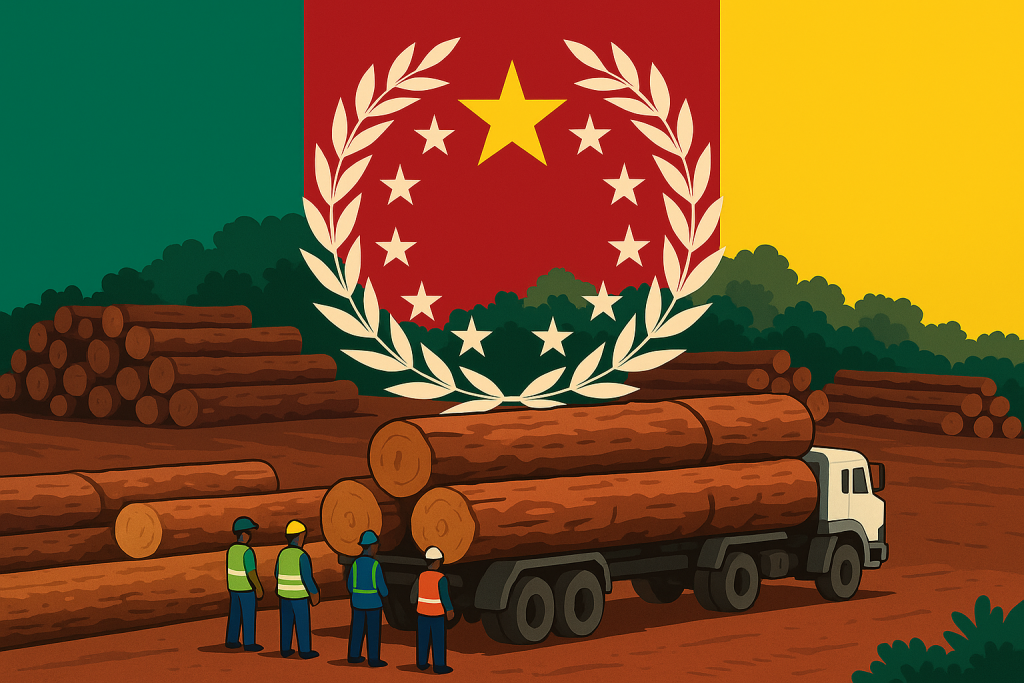
This week, the European Parliament voted on two significant texts proposing the termination of existing agreements between the European Union and Cameroon regarding forest governance and trade.
Together, these documents reflect a strategic reassessment by the EU of its trade relations with Cameroon in the critical sector of timber and forest management, highlighting evolving policy priorities and governance expectations.
The first document, the Recommendation on the draft Council decision (16.5.2025 – 05673/2025 – C10‑0012/2025 – 2024/0245(NLE)), formally seeks to terminate the Voluntary Partnership Agreement (VPA) that has governed legal timber trade, forest law enforcement, and sustainable governance practices between the EU and Cameroon. Accompanying this recommendation is a complementary Report containing a motion for a non-legislative resolution, which underscores the broader implications and motivations behind this decision.
This issue provides Ave Europa with an opportunity to critically reassess the broader concept of EU cooperation agreements with third countries, taking the case of Cameroon as a starting point.
This policy paper will specifically address: 1) the underlying reasons prompting the termination of the existing agreement; 2) the initial objectives and framework of the original Voluntary Partnership Agreement (VPA); and 3) Cameroon’s integration into the EU’s Global Gateway strategy.
The case of Cameroon raises broader concerns on the effectiveness of EU trade agreements to produce governance reforms, transparency, and legal compliance. The resolution not only terminates the VPA but also critically evaluates the EU’s broader policy frameworks for sustainability, governance, and international cooperation in trade, signaling a shift towards more integrated and potentially flexible partnership models under enhanced parliamentary scrutiny.
1- Background
The termination of the 2003 Voluntary Partnership Agreement (VPA) with Cameroon reveals the historical layering of the European Union’s legal, political, and developmental engagement with the African continent.
Originally framed by the 2003 FLEGT Action Plan as a governance-oriented legal instrument to combat illegal logging, the VPA evolved into a symbol of the EU’s broader commitment to environmental diplomacy and rule-of-law-based trade.
By 2009, the interim Economic Partnership Agreement (EPA) shifted emphasis toward commercial liberalization and market integration, reflecting a more trade-centric logic grounded in regulatory compliance and fiscal discipline.
The subsequent emergence of the Global Gateway strategy marks a new phase: project-oriented, investment-driven, and aligned with the EU’s “twin transition” priorities.
Lexically, one notes a drift from the formalist register of legality and verification toward a vocabulary of resilience, inclusivity, connectivity, and sustainability. Politically, the transformation mirrors the EU’s recalibration from conditionality-based governance frameworks toward pragmatic, geopolitical infrastructure partnerships.
Yet persistent tensions remain: between developmental rhetoric now tinged with indigeneity-inflected language, a strategic discourse on global connectivity and competitiveness, and a normative commitment to human rights and rule-of-law conditionalities.
The termination of the Cameroon VPA, triggered by systemic corruption, non-implementation, and deforestation trends, thus illustrates a broader inflection point in EU external action: away from legally binding governance tools and toward flexible investment logics under the Global Gateway, raising questions about coherence, credibility, and the future architecture of EU-Africa relations.
A- Background on the 2003 FLEGT Action Plan
The FLEGT Action Plan operationalised the EU’s strategy against illegal logging through a coordinated set of instruments combining development cooperation and trade policy.
On the supply side, it focused on strengthening forest governance in timber-producing countries—mainly in Africa, Asia, Latin America, and Russia—by financing legal and institutional reforms.
This included technical assistance for setting up legality verification systems, training of enforcement and customs staff, improving access to forest-related data, and supporting participatory forest management schemes.
National Forest Programmes served as a framework for policy reform, aiming to correct structural inequalities in forest access and promote the legal empowerment of local communities. These efforts were financed through EU budget lines dedicated to tropical forests and were often integrated into national Poverty Reduction Strategy Papers (PRSPs), treating legality as a minimal but necessary precondition for broader environmental and social goals.
On the demand side, the Action Plan established the principle of market access conditionality through a voluntary licensing scheme, implemented via bilateral FLEGT Partnership Agreements. Under this mechanism, only timber accompanied by verified legality licences could enter the EU market, starting with unprocessed wood products and leaving open the possibility of extending to processed goods.
The Plan complemented this with guidelines on green public procurement, encouraging EU Member States to privilege legal timber in public contracts, and with soft measures aimed at the private sector, including codes of conduct and due diligence frameworks for financial institutions.
While the regime remained formally non-compulsory, the Commission also committed to exploring binding legislation in the absence of multilateral progress, drawing inspiration from transnational legal models such as the US Lacey Act and the Kimberley Process.
The Plan, now terminated, represented a transitional architecture: not a comprehensive regulatory system, but a stepwise approach that framed legality as a shared interest to be negotiated between sovereign partners under EU influence.
B-
The preamble of the agreement reaffirmed its core objective: to promote sustainable development, good governance, and poverty reduction. It legitimised the agreement not as a mere trade liberalization treaty, but as a broader instrument of development cooperation.
Title I set out specific goals across eight priorities, including poverty reduction, economic diversification and competitiveness, regional integration, better integration into global trade, the strengthening of trade-related capacities, predictable regulatory frameworks, and support for the private sector and employment. The agreement was therefore positioned as both a commercial and developmental framework.
Title II, devoted to the trade partnership, stipulates that the European Community shall grant immediate duty, and quota-free access to all products originating from Cameroon, with the exception of arms and ammunition. In return, Cameroon committed to a progressive liberalization of approximately 80% of its imports over a twenty-year period. Rules of origin were defined to determine the products eligible for preferential treatment.
The agreement also emphasized the importance of technical and financial support from the European Union to help ACP countries adapt to the new trade framework, particularly regarding infrastructure, standards, and taxation. Lastly, the agreement included a dispute settlement mechanism based on a traditional triptych, consultation, mediation, and arbitration, modeled on the WTO system. While this mechanism formally upheld equality between the parties, its technical complexity significantly limits accessibility for African states with often limited administrative capacities.
2- Description
A- Terminating the Voluntary Partnership Agreement (VPA)
The European Commission’s main arguments for terminating the Voluntary Partnership Agreement (VPA) with Cameroon are: :
(1) persistent non-implementation by Cameroon of the agreement’s core provisions, particularly the Forest Law Enforcement, Governance and Trade (FLEGT) licensing scheme and legality verification systems;
(2) ongoing weak governance, resource shortages, and systemic corruption hindering enforcement;
(3) significant shifts in Cameroon’s timber exports toward Asian markets (China and Vietnam), where legality standards are weak or disregarded, severely undermining the VPA’s impact;
And (4) concerns over damaging the EU’s credibility as a global leader in forest protection, biodiversity conservation, and human rights standards. The legal procedure for termination involves the Council’s adoption of a decision, requiring consent from the European Parliament, with termination becoming effective 12 months after formal notification to Cameroon.
The Voluntary Partnership Agreement (VPA), effective since December 2011, aimed to ensure legal timber trade between Cameroon and the EU through rigorous legality verification, while also promoting systemic governance improvements such as stakeholder participation and transparency.
However, following a stalled joint review in 2023, the European Commission decided to unilaterally terminate the VPA, contemplating a shift from legally binding VPAs towards potentially looser forest partnerships, raising concerns within Parliament about transparency and stakeholder involvement.
Cameroon, which has maintained an interim Economic Partnership Agreement (EPA) with the EU since 2009, continues negotiations within a broader regional framework emphasizing alignment of trade instruments with sustainability requirements, particularly under the EU Deforestation Regulation.
Despite possessing substantial forest resources—covering approximately 40% of its territory—Cameroon lost roughly 900,000 hectares of forest (5% of its total cover) from 2011 to 2022, reflecting significant deterioration in forest governance during the VPA’s lifespan. The timber sector, Cameroon’s third-largest export sector to the EU after oil and cocoa, has increasingly redirected exports to China and Vietnam, weakening the EU’s regulatory incentives and facilitating illegal logging and associated revenue losses.
Cameroon notably failed to establish a fully operational Timber Legality Assurance System (TLAS), essential for issuing EU-required FLEGT licenses, and the intended support from the EU and the French Development Agency for the period 2021–2025 never materialized.
Persistent corruption and weak oversight, particularly related to small-scale logging permits (“ventes de coupe“), coupled with incomplete progress on timber traceability and a lack of credible independent audits, further undermined effective governance.
Additionally, an increasingly hostile environment and shrinking operational space for NGOs in Cameroon have severely compromised governance transparency. The European Parliament thus warns that while terminating the VPA could reinforce the EU’s credibility as a global leader against deforestation, it might simultaneously risk damaging its reputation as a reliable international partner.
B- Parliamentary review
The European Parliament broadly concurs with the Commission’s assessment regarding Cameroon’s non-fulfillment of its obligations under the Voluntary Partnership Agreement (VPA), noting significant deterioration in governance and persistent implementation shortcomings, thereby acknowledging the necessity of terminating the agreement.
The European Parliament emphasizes that VPAs require mutual commitment and proper enforcement to be effective. Its core recommendations highlight urgent ecological and social concerns linked to deforestation, advocate for the establishment of a robust Timber Legality Assurance System (TLAS), and underline the necessity for civil society involvement to tackle corruption and governance weaknesses.
The legislative body calls for concrete action to combat widespread corruption, strengthen human rights protections, improve transparency, and reinforce consultation mechanisms with local authorities. Recognizing failures within Cameroon’s existing forest governance framework, Parliament suggests exploring alternative cooperation models, such as forest partnerships, that ensure legality, sustainability, inclusivity, and robust parliamentary oversight.
However, Cameroon’s failure does not discredit VPAs as an effective instrument elsewhere; Parliament explicitly reaffirms their continued value and encourages negotiation of new VPAs.
Additionally, Parliament indicates support for integrating Cameroon within the EU’s Global Gateway strategy, reflecting a strategic shift toward potentially less stringent partnership models, thereby highlighting a broader policy tension between binding governance-focused VPAs and more flexible partnership frameworks.
2- Amendments tabled in committee
The amendments tabled in committee, across political groups, reflect clearly identifiable political priorities.
A first set emphasizes a strategic reorientation towards Southeast Asia, explicitly highlighting that “timber exports to other non-EU countries, such as China and Viet Nam, have increased dramatically,” illustrating an emerging geographic and economic concern.
Another category, notably championed by groups likely on the left or by the Greens, employs distinctly indigenous-rights-oriented language, emphasizing VPAs as tools to promote “state recognition, self-determination and self-governance rights” for indigenous communities, thus empowering local populations and countering extractive practices.
A further approach frames rural and agricultural development within third countries in terms of “sustainable and multifunctional agroforestry, soil and landscape protection,” clearly embedding trade policy in broader environmental and socio-economic sustainability objectives.
Additionally, several amendments underscore a distinctly inclusive, participatory ethos, stressing “the importance of including civil society and local authorities in decision-making processes” and advocating robust benefit-sharing mechanisms.
Critically, the discourse around combating deforestation explicitly integrates concerns over governance and rule of law, emphasizing the need to address “weak governance, ineffective law enforcement, insecure land tenures” and corruption, and calling for cooperation to shift decisively toward human rights protection and measures against corruption.
Taken together, these amendments suggest a significant evolution in EU international public law, potentially reshaping trade partnerships around a foundation explicitly grounded in human rights norms, while also marking a clear rise of the Global Gateway strategy as the predominant framework through which sustainable, inclusive, and green development cooperation is envisioned.
The agreement now being terminated—the Voluntary Partnership Agreement (VPA) between the EU and Cameroon—originated from a much earlier institutional context shaped by the 2003 Communication from the Commission to the Council and the European Parliament on Forest Law Enforcement, Governance and Trade (FLEGT), published under the title COM(2003) 251 final. At that time, the European Union still formally operated under the label “Commission of the European Communities,” and the communication itself followed a distinctly administrative and technocratic style—dense, linear, structured like a master’s thesis in Times New Roman, complete with an exhaustive table of contents and minimal graphic layout. The FLEGT Action Plan laid out in that document was ambitious in scope: supporting timber-producing countries, regulating trade, influencing public procurement and private sector practices, mobilizing finance, and even addressing conflict timber. Two decades later, the termination of one of its first operational offshoots—the Cameroon VPA—marks not only the limits of implementation but also how far the EU has evolved in its approach to international environmental governance, policy communication, and the design of legal instruments.
3. Cameroon and the Global Gateway
The Global Gateway Africa–Europe Investment Package is the European Union’s most ambitious initiative to foster sustainable, inclusive, and transformative growth across the African continent.
With €150 billion in investments, it channels support into five key pillars: accelerating the green and digital transitions, boosting sustainable growth and job creation, strengthening health and pharmaceutical systems, and investing in education and skills.
Implemented through a Team Europe approach, it brings together the EU, Member States, and European financial institutions to identify and deliver high-impact projects across priority sectors.
In the green transition, the Package backs renewable energy and clean hydrogen projects, climate resilience, biodiversity conservation, and sustainable agri-food systems.
Digitally, it aims to bridge the connectivity gap with investments in submarine cables, data infrastructure, and trusted digital ecosystems. Economic integration is promoted through modern transport corridors, support for SMEs and women entrepreneurs, and the development of sustainable value chains, including in raw materials.
The initiative also supports African health sovereignty through regional pharmaceutical production and vaccine access, while education and youth mobility are fostered to align skills with labour market needs.
To unlock financing, the EU combines grants, loans, guarantees, and blended finance, supports the development of green bond markets, and contributes to IMF mechanisms like the Poverty Reduction and Growth Trust. Altogether, the Package positions the EU as a long-term partner in Africa’s green, digital, and socio-economic transformation.
The EU’s partnership with Cameroon, under the Global Gateway strategy, reflects a multidimensional approach that combines sustainable development, economic integration, and geopolitical stability.
With €244 million in grant funding for 2021–2027, the EU and its Team Europe partners (including France, Germany, and the EIB) are engaging across key sectors. Efforts in the conflict-prone northern regions focus on agri-food resilience, cotton and energy value chains, decentralised governance, and conflict prevention.
Major infrastructure investments—such as the Nachtigal and Kikot hydropower dams and the Logone River bridge—advance both the energy transition and regional connectivity.
In parallel, the EU supports sustainable value chains (notably cocoa and forestry), biodiversity conservation, and inclusive migration policies, including durable solutions for displaced persons and Central African refugees. Strategic investments in transport and digital infrastructure complement reforms in education, vocational training, and governance, positioning Cameroon as both a partner in regional peace building and a beneficiary of the EU’s green and inclusive growth agenda.
In line with the Global Gateway strategy, Cameroon hosts several flagship projects designed to accelerate its green and infrastructure transitions while fostering inclusive economic growth.
First, the construction of the Nachtigal hydroelectric dam on the Sanaga River, with a capacity of 420 MW, aims to cover approximately 30% of the country’s electricity needs while exporting surplus energy to Chad. This run-of-river installation, supported by the European Commission, EIB, and Finland, is expected to generate 2,100 GWh annually and reduce CO₂ emissions by 850,000 tonnes per year, contributing significantly to the country’s low-carbon energy trajectory.
Second, the Yaoundé bypass project—an 89-kilometre infrastructure development—seeks to divert heavy transit traffic from the urban core, improving safety and mobility while stimulating economic development across 1,200 hectares of planned urban hubs. By easing transport on the Kribi/Douala-Ndjamena corridor, it reinforces regional connectivity and reduces urban congestion, with environmental co-benefits.
Finally, the modernisation and energy transition of Sodecoton, co-financed by the EU and AFD, aims to rehabilitate and expand cotton processing capacities, secure producer prices, and install five photovoltaic units. This intervention supports both industrial upgrading and environmental governance in Cameroon’s cotton sector, consolidating a more sustainable and resilient agri-industrial base. These projects exemplify the EU’s integrated approach combining climate, energy, transport, and productive investment under the Global Gateway framework in Sub-Saharan Africa.
Despite the end of the stamp agreement, Cameroon remains an attractive destination for European investments. However, these investments are now being redirected toward more strategic sectors, particularly transport and energy infrastructure. This shift reflects a desire to support the country’s long-term growth by strengthening regional connectivity and energy capacity, key elements for attracting further capital and fostering sustainable economic development.