Mourning the tragedy of Tempi, Ave Europa urges the creation of an intergovernmental task force and a special parliamentary committee to confront the continent’s deteriorating railway infrastructures.
In ancient Greece, the valley of Tempi was a sacred place — a narrow pass between mountains, a mythical threshold between the world of humans and the realm of the gods. A space of transition, of revelation, of meaning.
Today, the name Tempi evokes something entirely different: the image of a modern state unable to guarantee safety on its own railways. A place where the boundary is no longer between the human and the divine, but between life and death, responsibility and neglect.
This contrast speaks to more than the accident itself. It reveals the growing gap between the idea that Greece represents — the cradle of civilisation, of political reason, of governance — and the contemporary reality of a system faltering under the weight of its own dysfunction.
Europe cannot afford to ignore this symbol. It must care for Greece — its cradle, its mirror, its warning. For if Greece descends into institutional powerlessness, it risks becoming the allegory of Europe’s own failure to govern itself.
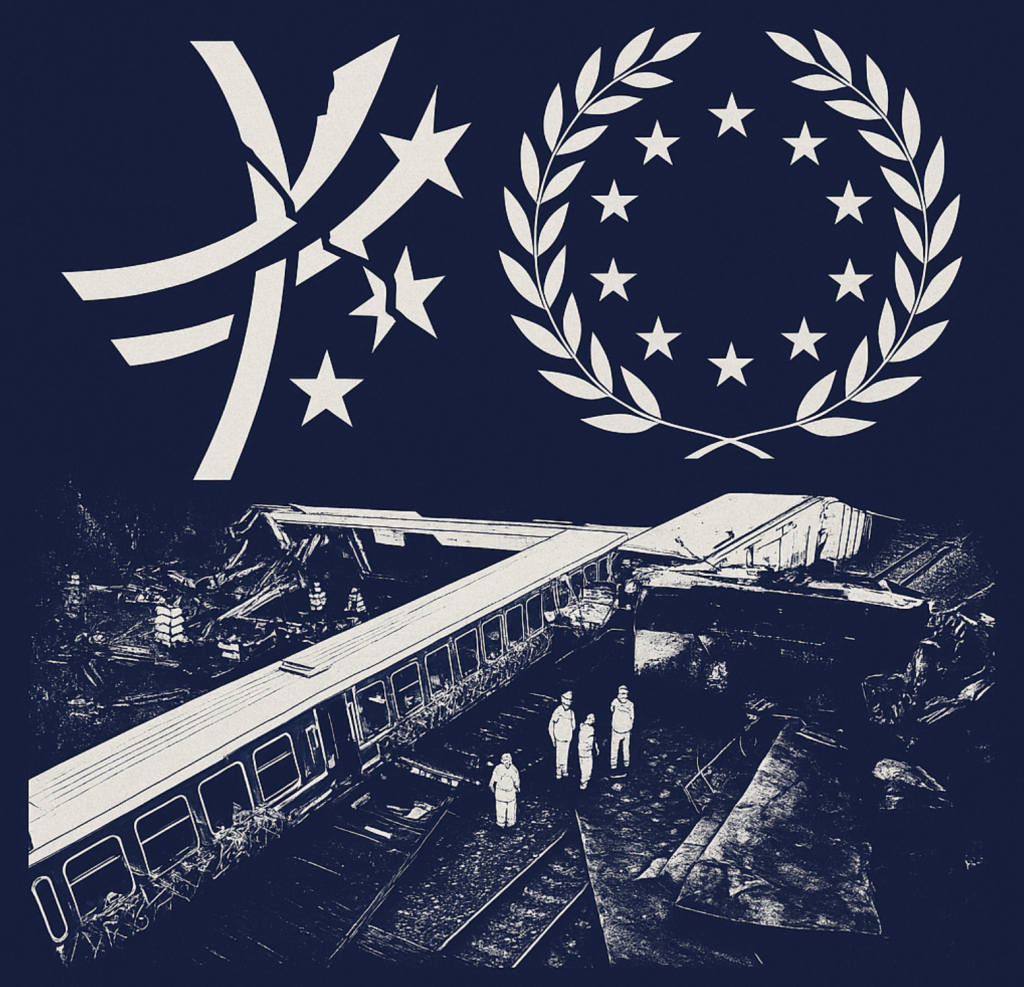
Two years after the tragic rail accident in Tempi, Greece, in which 57 people lost their lives, we remain haunted not only by the loss of human life but by what this disaster revealed: the systemic failure of a state apparatus incapable of fulfilling its most basic responsibilities.
As the judicial investigations drag on and political accountability remains largely symbolic, the broader European question emerges: Can the European Union afford to continue tolerating such dysfunction within one of its member states?
Is it right to call Tempi a “tragedy” – though ?
The word suggests fatal necessity — something deeper than an accident, more systematic than misfortune. What happened in Tempi was not a random event. It was the predictable outcome of long-standing dysfunction: the consequence of negligence, structural decay, and institutional inertia.
If it was a tragedy, it was one shaped by human hands, not by impersonal fate, one that could, or should, have been prevented.
Remembering Tempi: The Tragedy and Its Aftermath
On February 28, 2023, a passenger train collided with a freight train in central Greece, due to a combination of human error, inadequate infrastructure, and outdated safety systems. The tragedy sparked national mourning, mass protests, and temporary political gestures, but little structural change.
The media coverage was intense, and the initial outrage was palpable. However, as is often the case in Greece, attention waned, judicial proceedings stagnated, and the deep-rooted problems remained unaddressed. Despite promises, the government failed to deliver a credible reform plan, and infrastructure upgrades remain superficial.
Government Inefficiency: A Longstanding Crisis
To understand Tempi is to understand the modern Greek state: decades of administrative failure, partisan appointments, and chronically underfunded public services. The railways in particular were allowed to deteriorate, with layers of mismanagement dating back to the post-dictatorship era of 1974.
This is not merely a failure of one administration. Practically every Greek government since the restoration of democracy has contributed to the decay through disregard for long-term planning. Even recent privatisation efforts, such as the sale of the Greek railways to the Italian company Trenitalia, were marred by geopolitical calculations and a lack of strategic oversight.
The European Question: Complicity or Solution
Is the EU to blame? No — but it is certainly complicit by omission.
European funds have flowed into Greece for decades, and yet the misuse, misallocation, and often sheer waste of these resources is an open secret in Brussels.
Monitoring mechanisms are weak, enforcement of European standards sporadic, and conditionality all but toothless. Greece’s integration into the EU has been more formal than functional in many critical sectors.
This brings us to a central question: Should the EU have more authority to monitor and enforce standards in national infrastructure and public safety? We believe the answer is unequivocally yes.
Toward a Federal Europe: Coordination Where States Have Failed
Greece, in its current institutional state, does not possess the capacity to manage essential sectors alone. This is not a moral indictment of the Greek people, but a practical recognition of a systemic collapse that has been decades in the making. For the sake of future generations, and for the credibility of the European project itself, we must be bold enough to propose EU-level coordination where national governments have demonstrably failed in managing key public infrastructures.
Rather than defaulting to punitive rhetoric or sterile national blame, we advocate for a coordinated European response, with pragmatic steps to bring our rail systems into the 21st century.
We therefore call for two immediate initiatives:
A European Railway Taskforce, first. We propose the creation of a governmental-level initiative bringing together the most advanced and reliable national railway systems, notably those of Germany, France, the Netherlands, Austria, and others, into a taskforce dedicated to shared innovation, technical standards, safety protocols, and crisis prevention strategies. This intergovernmental group would serve as an incubator for best practices and strategic cooperation, offering guidance and pressure on lagging systems such as Greece’s.
A Special Parliamentary Committee on European Rail Infrastructure, then. We also call upon the European Parliament’s Committee on Transport and Tourism (TRAN) to establish a special ad hoc committee with a broad and urgent mandate: investigate the state of rail infrastructure across all member states ; assess the competitiveness and resilience of the European rail industry ; examine the sharing of maintenance practices and safety protocols ; identify and promote cross-border rail interconnections ; and crucially, request from the European Commission a comprehensive review of the EU’s rail networks, accompanied by a draft budget for priority maintenance and urgent public works, particularly in underperforming regions.
This is not about technocratic tutelage : it’s about restoring credibility, safety, and vision to one of Europe’s most vital infrastructures. In the 21st century, no EU citizen should die in a train crash caused by 20th-century neglect.
Conclusion
The Tempi tragedy must mark a turning point — not only in how Greece addresses its structural shortcomings, but in how Europe rethinks its governance framework.
This is not just about national responsibility, but about European interdependence.
A European Union that aspires to be more than a market must ensure that no member state operates below basic standards of safety, accountability, and public service delivery. Infrastructure failure in one country is a shared risk for all.
Federalisation is not a political fantasy — it is a governance necessity. By centralising oversight and coordination in critical areas such as transport infrastructure, the EU can help prevent avoidable tragedies, ensure consistent standards, and reinforce the rule of law where national administrations struggle to enforce it.
This is not about diminishing sovereignty — it is about enabling states to govern more effectively through shared responsibility and mutual support. It is about protecting lives, restoring trust, and making sure that what happened in Tempi never happens again — in Greece or anywhere in Europe.