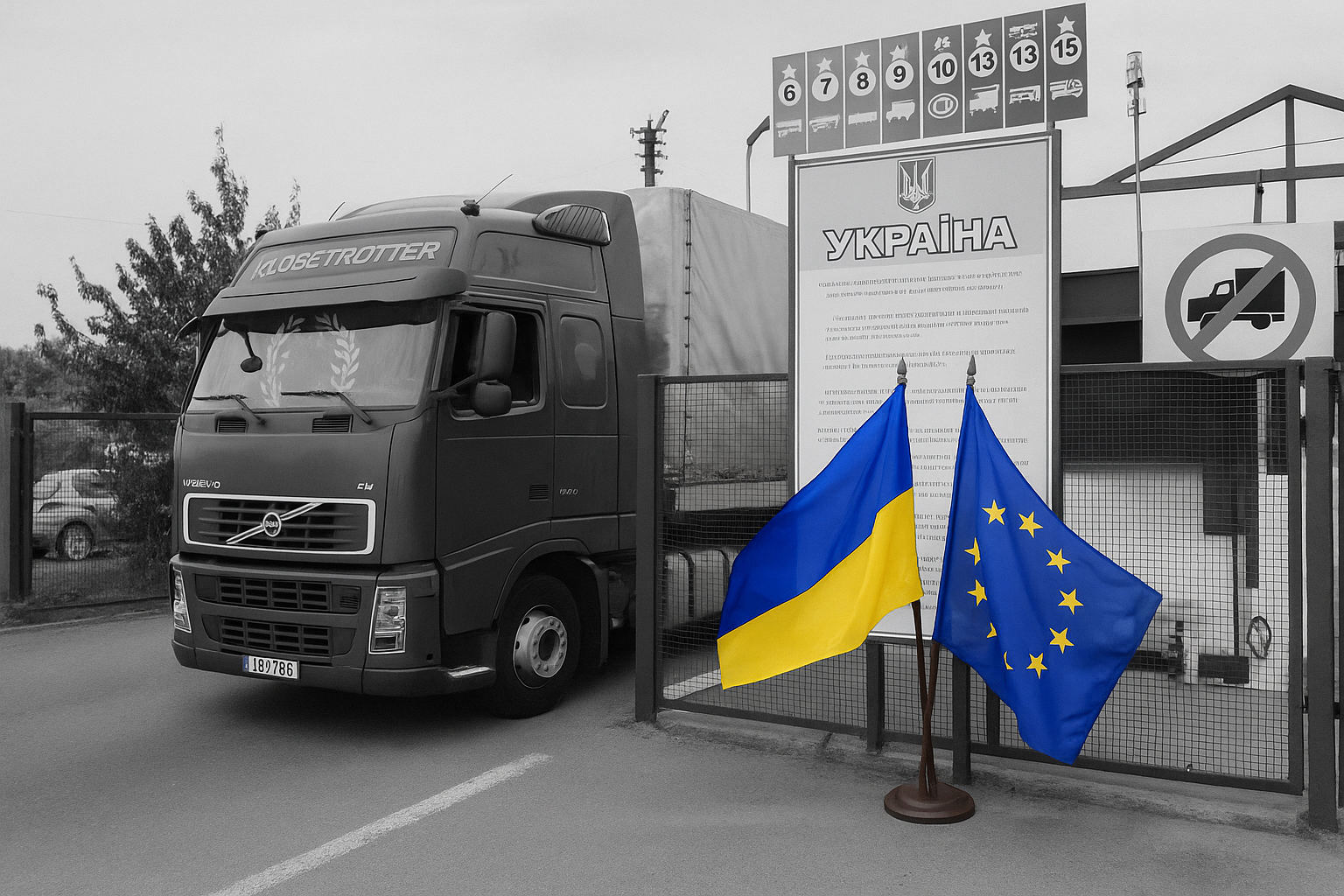
The text submitted to the European Parliament concerns the approval, on behalf of the Union, of an agreement signed with Ukraine on 20 June 2024, which amends the original EU-Ukraine road freight agreement of 29 June 2022.
This agreement, provisionally applied since its signature, temporarily liberalises bilateral and transit freight transport between the EU and Ukraine by removing permit requirements for Ukrainian hauliers and recognising Ukrainian driving licences, even if expired.
It includes enforcement tools such as a cooperation mechanism against document fraud, a joint committee for monitoring and adaptation, and safeguard clauses. The legal basis lies in Articles 91 and 218(6)(a) TFEU, and the agreement is subject to the European Parliament’s consent.
Initially adopted in the wake of Russia’s invasion, the agreement aims to ensure the continuity of supply chains amid port blockades and airspace closures. It has become a cornerstone of the EU’s Solidarity Lanes, helping to stabilise Ukraine’s economy and maintain agri-food exports, notably grain.
Since its provisional application, the agreement has generated a 42% increase in EU imports from Ukraine and a 37% increase in exports to Ukraine. While effective in preventing a logistical breakdown, it has also sparked concerns in certain Member States, especially Poland, where transport and agricultural sectors denounce unfair competition and market distortions.
The amended version, proposed by the Commission and signed in June 2024, addresses technical implementation issues raised by Member States and prolongs the agreement until 30 June 2025, with possible automatic extensions.
Article 11 limits its application to Ukrainian government-controlled areas, reflecting the wartime context. Though temporary, the agreement is legally autonomous and closely linked to Article 136 of the EU–Ukraine Association Agreement on transport liberalisation. It functions as a vector of regulatory alignment and de facto integration into the internal market, with clear implications for Ukraine’s long-term accession. In March 2025, the TRAN committee rapporteur recommended rejecting the amended agreement, but in April, a cross-party coalition tabled amendments supporting its continuation.
The rapporteur, Siegbert Frank Droese (ESN), recommends that the Parliament withhold its consent to the conclusion of the agreement. In his view, the text fails to meet the security, fairness, and reciprocity standards that should underpin any liberalisation of road transport. He specifically criticises the lack of effective border and roadside controls, particularly concerning driving times, the technical condition of vehicles, and the validity of transport documents.
The rapporteur also laments the absence of restrictions on the volume of Ukrainian goods entering the EU market, especially agricultural products such as wheat, which he claims harm producers in the Member States, as illustrated by repeated protests from the Polish farming sector.
Furthermore, he expresses concern over the lack of clarity regarding the transport of dual-use goods and calls for the scope of the agreement to be limited to civilian cargo only.
Ultimately, he argues that the amended agreement does not ensure fair competition between European and Ukrainian hauliers and that a renegotiation, including safeguard clauses, systematic digital controls, and sectoral limitations, would be preferable.
The political groups PPE, S&D, Renew, Greens/EFA, The Left, and ECR expressed a shared position in favour of the agreement and rejected the rapporteur’s recommendation.
For these groups, the agreement is a vital support mechanism for Ukraine’s wartime economy and helps sustain commercial exchanges in a context of severe logistical disruption.
They stress that the amendments introduced in the updated text address the implementation challenges identified by Member States while preserving the overall integrity and effectiveness of the scheme.
They further highlight that the agreement also benefits the European Union, notably by facilitating exports to Ukraine and strengthening the resilience of its own supply chains.
Maintaining the agreement is, in their view, a concrete act of solidarity that contributes to regional stability and to the gradual integration of Ukraine into European structures.
Ave Europa fully aligns with the counter-position expressed by the groups supporting the agreement.
The group supports the immediate extension of this instrument, which it sees as a strategic lever for deepening Ukraine’s de facto integration into the European internal market, particularly in a key sector such as transport.
Ave Europa considers that the European Union must use the wartime period to advance Ukraine’s functional alignment with EU policies, standards, and infrastructure, in order to make its eventual formal accession both technically and politically feasible as soon as the conflict ends.
The road freight transport agreement stands as a concrete example of this accelerated integration strategy. Our group acknowledges that certain technical adjustments may be required to ensure fair competition, but believes that such measures should not undermine the liberalised access of Ukrainian hauliers to the European market.
The EU–Ukraine road transport agreement is more than a logistical tool: it is a political instrument of pre-accession.
It should be renewed while being periodically rewritten to ensure road safety, document control, fair market protection, and the irreversible anchoring of Ukraine in the European economic area.
Accordingly, Ave Europa would have voted in favour of the amendments proposed by the groups and against the far-right rapporteur’s recommendation.