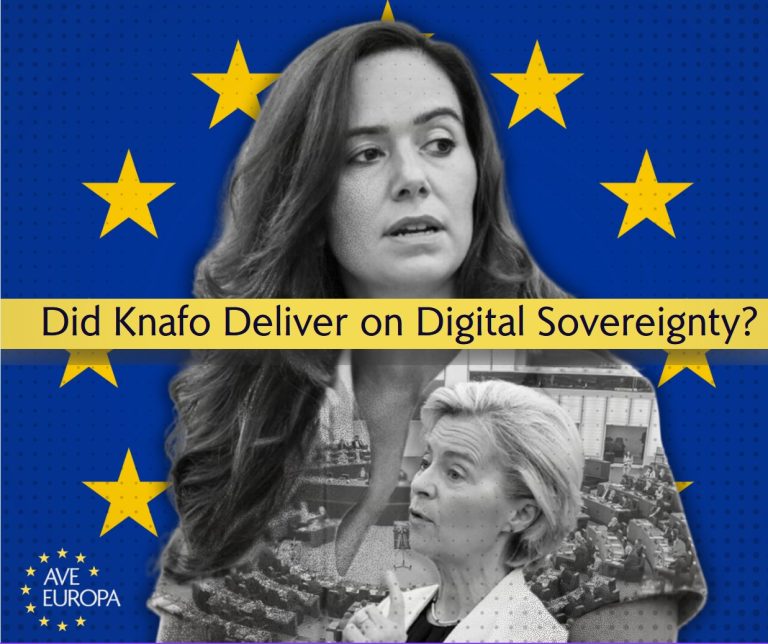
We reject censure—but demand scrutiny, transparency, and accountability : a federalist case for a stronger Parliament over populist disruption.
The members of Ave Europa reached a common position regarding the motion of censure tabled by the PfE and ECR groups in the European Parliament, which seeks to censure the President of the Commission1.
In a parliamentary context, we would have voted against this motion, which is driven by a political group fundamentally opposed to the very idea of a federal Europe.
Far from seeing this as an opportunity to topple the Commission, we instead view it as a chance to reflect on rebalancing institutional powers in favour of the Parliament.
This motion brings together four distinct matters, not all of which have been fully substantiated. However, the lack of a sufficient legal basis should not preclude the question of strengthening the role of the Parliament, particularly within a federalist framework.
This includes strengthening parliamentary inquiry committees, fostering dialogue between the judiciary and the Parliament on the legality of Commission acts, enhancing the powers of audit authorities over the Commission’s actions, and giving greater weight to the legal opinions issued by the JURI Committee.
We believe that how the Commission manages this moment could serve as a catalyst to revitalise democracy within the Parliament and to address broader issues of transparency, accountability, and effectiveness.

1. General Position
We do not support the motion of censure against the von der Leyen Commission.
Our position is based on several key considerations.
First, institutional stability must prevail. We believe it would be inappropriate to call for the resignation of the current Commission before the Multiannual Financial Framework (MFF) has been fully concluded. The continuity of leadership is necessary to ensure an orderly closure of this key cycle.
Second, the current team includes valuable members who contribute significantly to the strategic direction of the EU. In particular, figures such as Commissioner Kubilius play a central role. It would be unwise to demand their departure before the natural political cycle has run its course.
Third, the political forces leading this initiative—especially the PfE group—pursue a broader agenda aimed at dismantling the European Union. Supporting this motion would amount to legitimising a project fundamentally at odds with our vision of European integration.
Lastly, we believe in democratic rotation at the executive level, but such transitions should occur in a calm and constructive framework. A leadership change could be envisioned in 2028, alongside the launch of the next MFF (2028–2035), in order to carry a renewed strategic roadmap. This would not reflect political disavowal, but rather institutional maturity and democratic health.
2. Analysis of the Allegations
The motion bundles together four separate issues. Each of them requires a differentiated assessment.
A. Pfizer SMS Case
The ruling of the Court of Justice of the European Union requires the disclosure of exchanges between President von der Leyen and Pfizer CEO Albert Bourla.
It is entirely legitimate for the European Parliament to demand a transparent and comprehensive assessment of the investigation’s status, responsibilities, and institutional lessons.
This situation does not justify a censure, but rather demands stronger transparency mechanisms.
Our position is clear: we support enhanced transparency, including judicial oversight and parliamentary inquiries.
B. SAFE Programme (Defence Industry, Article 122 TFEU)
The JURI Committee issued a non-binding yet symbolically significant opinion questioning the legal basis of the SAFE programme.
It would be institutionally appropriate for the Commission to reconsider the legal foundation it chose, even if it is not formally bound by JURI’s opinion.
The broad use of Article 122 to fund long-term defence projects raises legitimate questions and deserves thorough debate, but not immediate sanction.
We are open to a serious legal and institutional discussion, without directly challenging the legitimacy of the Commission.
C. Alleged Electoral Interference
The facts remain insufficiently substantiated to justify a motion of censure.
Should further evidence emerge, it would highlight the need to regulate the use of the Digital Services Act (DSA) more carefully during electoral periods.
A working process should be launched in the EUDS Committee to assess possible abuses and explore post hoc review mechanisms, including referral to the Court of Justice for interpretative opinions.
We support a stronger regulatory framework, but the current accusations lack legal foundation.
D. Management of COVID Recovery Funds
The report by the European Court of Auditors alledges genuine management failures.
If substantiated, these shortcomings should be addressed by the Commission through corrective measures under parliamentary oversight.
This situation strengthens the case for expanding the auditing powers of the Court of Auditors and for more robust follow-up by the European Parliament.
We call for improved fiscal accountability. While the criticism is valid, it calls for institutional reforms—not the dismissal of the Commission.
3. Political Perspective: Towards a Stronger, More Federal Parliament
Beyond the motion itself, this episode illustrates the urgent need for institutional reform.
The European Parliament should be able to exercise meaningful and structured oversight. This includes expanding the powers of inquiry committees, reinforcing the Court of Auditors as an independent audit authority, clarifying the legal weight of parliamentary committee opinions (such as JURI), and enabling post hoc scrutiny of Commission actions—particularly in sensitive political contexts such as elections.
In this light, even if the motion is politically driven and sometimes disproportionate, it opens a useful democratic space for debate. By embracing transparency, scrutiny, and accountability, the Commission can reinforce—not weaken—its legitimacy. Hiding behind procedural legitimacy is no longer sufficient.
4. Looking Forward: Checks, Dialogue, and a Stronger Parliamentary Role
This parliamentary commission, far from being a populist threat to the European Union, must be seen as an opportunity. It should serve as a democratic interface through which European political parties can question, challenge, and ultimately reinforce the role of the Parliament vis-à-vis the Commission.
This is fully in line with a logic of institutional checks and balances—from which the Commission would emerge more transparent and more legitimate.
Several constructive institutional avenues could be pursued:
First, it would be appropriate to establish a custom of respectful engagement between the Commission and the European Parliament, particularly when the JURI committee issues legal opinions. While non-binding, these opinions carry political and symbolic weight. The Commission could make a practice of re-evaluating its legal bases in light of such input, in a spirit of mutual institutional respect within the interinstitutional triangle.
Second, the European Court of Auditors should be empowered with a more prominent role. It could be invited to present findings before Parliament, which would then amend, vote on, and potentially act upon the reform recommendations or even sanctions outlined in its reports. This would mark a shift toward more structured financial oversight and post-legislative scrutiny.
Third, the Parliament should have the ability to establish independent investigative commissions, involving national executives, judges from the CJEU and the European Court of Human Rights, as well as relevant institutional actors. These commissions could intervene upstream of regulatory action—assessing legal soundness or governance risks—as well as post hoc, through inquiries and hearings to clarify contested actions, refine the legal framework, or even influence jurisprudential developments.
Finally, if the alleged use of the DSA for electoral interference were to be substantiated, it would merit at the very least a formal debate in the EUDS committee. This would help define the legitimate scope of public intervention on digital platforms during electoral periods, to prevent any discretionary or politically biased applications of the regulation.
In short, this episode is a powerful reminder of the need to strengthen the role of the European Parliament and to further legitimize the European Commission by making its governance more transparent, more responsive to democratic critique, and ultimately more robust.
A Commission that embraces scrutiny and reform is not a weakened institution—but a stronger and more credible one.
5. Conclusion
We would certainly vote against the censure, bore by MEPs fundamentally hostile to federalism.
But our opposition to the resolution does not wrap the Commission in a blanket immunity.
We demand answers—not resignations. Transparency, accountability, and a strong democratic oversight culture are levers for institutional strength, not signs of fragility.
In this perspective, the Commission has everything to gain by submitting to parliamentary scrutiny and independent judicial review. It will not lose its competences—it will reinforce its legitimacy.
Annex
Filed under Article 131 of the Rules of Procedure of the European Parliament, motion of censure (2025/2140(RSP)) brought forward by Gheorghe Piperea, a Romanian member of the European Conservatives and Reformists (ECR) group, aims to challenge the European Commission presided over by Ursula von der Leyen. It is supported in France by Virginie Joron and Thierry Miriani, both involved in Aurélian Simion’s electoral campaign in Romania, and notably signed by Sarah Knafo. Marion Maréchal, however, did not sign it.
The text calls for the resignation of the Commission on the grounds of repeated failures in transparency, democratic governance, and respect for the rule of law. It asserts that the current presidency no longer inspires the Parliament’s confidence and has failed in its mission to uphold the fundamental principles of the Union.
The motion consolidates four separate cases which, according to its authors, illustrate a consistent pattern of institutional drift and democratic disconnect:
The affair concerning SMS exchanges between Ursula von der Leyen and the CEO of Pfizer, linked to the lack of transparency surrounding vaccine purchase contracts;
Criticisms of the legal basis for the SAFE programme, financed via Article 122 of the TFEU, which has been diverted from its original purpose;
Allegations of electoral interference in Romania, through a contested application of the Digital Services Act;
Lastly, the allegedly poor management of COVID funds, including significant losses and shortcomings highlighted by the European Court of Auditors.
2. Content of the Motion
A. On von der Leyen’s SMS with Pfizer
The motion recalls that transparency is a fundamental democratic requirement, especially during a health crisis and major budgetary commitments. It refers to the investigation opened in 2022 by the European Public Prosecutor’s Office concerning the vaccine purchase negotiations, which is still ongoing in 20252.
The authors also cite the EU General Court’s order of 5 October 2023 (case Stevi and The New York Times v Commission)3, which deemed the Commission’s justification for refusing to disclose documents related to these contracts insufficient. The 14 May 2025 decision annulling the refusal to release the SMS exchanges between Ursula von der Leyen and Albert Bourla is highlighted as evidence of a failure to meet transparency obligations under Regulation (EC) No 1049/20114.
The Commission is thus accused of violating the principles of transparency, good administration, and institutional accountability, and of no longer deserving the Parliament’s trust.
B. On Allegations of Electoral Interference
The motion denounces the misuse of Regulation (EU) 2022/2065 on digital services (DSA) for political purposes5. This regulation, designed to oversee large digital platforms, is said to have been diverted from its purpose to restrict political expression and hinder certain electoral campaigns, notably in Romania, where candidate Simion is claimed to have been disadvantaged, but also in Germany (with regard to the AfD).
The authors consider this electoral interference to be a serious violation of the principle of Member State sovereignty and the Commission’s democratic mandate. They claim it demonstrates the instrumentalisation of a legislative text for political ends.
C. On the Management of COVID Funds
The motion strongly criticises the use of €35 billion for vaccine purchases, pointing out that around €4 billion worth of doses went unused. This waste is presented as indicative of failures in administrative and budgetary management during the crisis.
It notably draws on Special Report 22/2024 from the European Court of Auditors (26 September 2024), which highlights shortcomings in the implementation of the Recovery and Resilience Facility (RRF)6. This feeds doubts about the Commission’s ability to manage large-scale EU funds rigorously.
D. On the SAFE Programme and the Reproach from the JURI Committee
Lastly, the motion refers to the non-binding opinion issued on 23 April 2025 by the Parliament’s Legal Affairs Committee (JURI), which rejects the legal basis chosen for the SAFE programme. According to JURI, Article 122 of the TFEU, intended for economic emergencies, cannot justify massive and structural funding in the field of defence7.
The SAFE instrument, with a declared amount of €150 billion, is thus said to rely on an excessive and legally questionable interpretation of the Treaty. The authors see this as an abuse of power that undermines the Union’s legal certainty and signals a drift toward technocratic governance detached from legitimate frameworks.
Conclusion of the Motion
The motion concludes that all these elements point to a breakdown of trust between the Commission and the Parliament. It accuses the von der Leyen presidency of disregarding the fundamental requirements of transparency, accountability, and respect for the rule of law. Consequently, it formally calls for the resignation of the European Commission.
Motion of Censure on the Commission – 3 July 2025 (2025/2140(RSP)) Pursuant to Rule 131 of the Rules of Procedure https://www.europarl.europa.eu/doceo/document/B-10-2025-0319_EN.html
https://www.eppo.europa.eu/en/media/news/investigation-acquisition-covid-19-vaccines-clarifications
Judgment – 14 May 2025 – Stevi and The New York Times v Commission Case T-36/23, Reports of Cases, published in the electronic Court Reports (Court Reports – General) (Appeal pending before the Court of Justice: Case C-634/23 P(I)) https://curia.europa.eu/juris/document/document.jsf;jsessionid=38990C84FF5ABC1BE4ABA84C689465A0?text=&docid=299492&pageIndex=0&doclang=en&mode=lst&dir=&occ=first&part=1&cid=988717
https://www.ombudsman.europa.eu/en/decision/en/158295
Regulation (EU) 2022/2065 of the European Parliament and of the Council of 19 October 2022 on a Single Market for Digital Services and amending Directive 2000/31/EC (Digital Services Act)
OJ L 277, 27 October 2022, pp. 1–102 (Text with EEA relevance)
Legal status: In force – ELI: http://data.europa.eu/eli/reg/2022/2065/oj
Paragraph 82 : “A third category of risks concerns the actual or foreseeable negative effects on democratic processes, civic discourse and electoral processes, as well as public security.” ; Article 34. Risk assessment: “any actual or foreseeable negative effects on civic discourse and electoral processes, and public security” ; CHAPTER IV IMPLEMENTATION, COOPERATION, PENALTIES AND ENFORCEMENTSECTION 3 European Board for Digital Services
The report : https://www.eca.europa.eu/ECAPublications/SR-2024-22/SR-2024-22_EN.pdf ; the reply of the Commission : https://www.eca.europa.eu/Lists/ECAReplies/COM-Replies-SR-2024-22/COM-Replies-SR-2024-22_EN.pdf ; “double funding with EU money : beware of the blind sport” : https://www.eca.europa.eu/en/news/NEWS-SR-2024-22
Council’s report : https://www.europarl.europa.eu/RegData/docs_autres_institutions/commission_europeenne/com/2025/0122/COM_COM(2025)0122_EN.pdf ; in-depth analysis by the Parliament’s research service : https://www.europarl.europa.eu/RegData/etudes/IDAN/2025/764354/ECTI_IDA(2025)764354_EN.pdf ; Briefing of the Europarl : https://www.europarl.europa.eu/RegData/etudes/BRIE/2025/769579/EPRS_BRI(2025)769579_EN.pdf ; Euractiv coverage (fr.) : https://www.euractiv.fr/section/defence/news/rearm-europe-la-commission-juri-du-parlement-europeen-rejette-la-procedure-legislative-durgence/ ; briefing about art. 122 of the TFUE : https://www.europarl.europa.eu/thinktank/en/document/EPRS_BRI(2025)769579 ; follow-up : https://www.eunews.it/en/2025/06/26/metsola-to-appeal-against-eu-council-over-fast-track-procedure-on-european-rearmament-plan/ ;